ADVERTISEMENT
ADVERTISEMENT
 (No Ratings Yet)
 Loading...
Fullscreen
ADVERTISEMENT


 (No Ratings Yet)Loading...
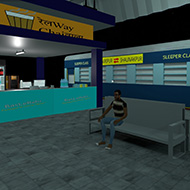
In Railway Chai Wala you start with a small cart, a kettle, and a platform about to fill up, and that matters once the first train pulls in. There’s no warm-up round — passengers start drifting toward the cart almost immediately. Nothing explains itself beyond what you can see: a kettle, a counter, a schedule you can’t read yet.
The loop is a simple exchange: a passenger approaches, asks for tea, and waits a limited time before giving up. Serving one is quick alone, but once two or three overlap, the single kettle becomes the bottleneck.
There’s no way to serve two people at once. Every decision comes down to reading who’s about to leave versus who can still wait.
That single-kettle constraint is really the whole game’s tension source — the schedule and the crowd size just add pressure to that one bottleneck.
Trains arrive on their own schedule, and each one dumps a fresh wave of passengers onto the platform at once, which is when the queue spikes hardest. Handling a rush well means clearing the queue before the whistle signals the next wave.
Ignoring the whistle cue is a common way a shift falls apart. Passengers who arrive mid-rush have shorter patience than ones who wandered up during a quiet stretch.
By the second or third train, the platform rarely fully empties between waves, which is where the difficulty quietly rises without any new mechanic.
Nothing tells you upfront how long a passenger will wait, so the early minutes amount to guesswork — serving whoever’s visible and learning timing through lost customers.
A few things become clear after a rough first shift:
Beginners fixate on serving fast rather than smart, which backfires once a rush hits and speed alone can’t clear a stacked queue.
The kettle isn’t infinite within a serving cycle — leave it running too long between refills and the tea becomes part of what you’re managing, alongside the queue and the clock.
A single serving cycle plays out in a fairly consistent order:
Once that cycle becomes automatic, difficulty shifts from execution to prioritization — deciding who gets served next when several passengers are close to leaving at once.
Experienced players stop watching the crowd and start watching the platform clock, since it predicts a rush before passengers appear.
It’s a subtle adjustment nothing in the game teaches explicitly, so most players stumble onto it after a few rough shifts.
The trade-off is honest: watching the clock means occasionally missing a passenger’s cue that they’re about to walk off.
Railway Chai Wala keeps its systems small enough to explain in a sentence, but the pressure of a single kettle against a platform that refuses to stay empty makes a clean shift feel earned. That whistle cue — realizing a fresh wave is already coming before the current line has cleared — is the detail that sticks with most players.
There are no reviews yet. Be the first one to write one.