ADVERTISEMENT
ADVERTISEMENT
 (No Ratings Yet)
 Loading...
Fullscreen
ADVERTISEMENT


 (No Ratings Yet)Loading...
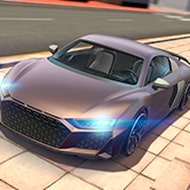
Extreme Car Driving Simulator looks like a casual arcade racer from a screenshot, but it plays like a physics sandbox that punishes anyone who treats it that way. There is no lap timer forcing you forward and no scripted route to follow — just an open city, a car with real weight behind it, and however much trouble you want to get into along the way. That gap between look and demand is exactly why it has held onto a dedicated following.
| Genre | Open-world driving simulation |
| Platform | Browser |
| Core loop | Drive, drift, tune, repeat |
The map is a full open city rather than a single track, with landmarks, side streets, and highways stitched together into something worth exploring on its own. Extreme Car Driving Simulator leans on that scale — long straightaways for building speed, tighter downtown blocks for testing braking, and highway ramps that reward commitment over second-guessing.
Early in the game, most players just drive in loops getting a feel for how the car reacts to the environment, since the physics engine responds differently on every surface. A wide highway lane forgives sloppy steering that would send the same car into a curb two streets over downtown.
Players who enjoy open-ended exploration over set objectives tend to gravitate toward simply roaming the city. The map itself is the content for them, not a means to some other end.
AI traffic fills the streets once you leave the emptier practice areas, and weaving through it is one of the more talked-about parts of the game. Other cars follow their own lanes and react to your movement, so a clean pass at speed feels earned in a way empty-road driving never matches.
Beginners often misjudge gaps because the car’s weight carries momentum through a turn longer than expected, clipping a bumper that looked clearly avoidable a second earlier. Reading traffic patterns rather than reacting to them is one of the clearer signs a player has moved past the early stage.
By the time dense traffic at speed feels manageable, switching into the dedicated Traffic mode feels like a natural next step. It rarely feels like an entirely new skill to learn.
If there is one thing community discussion circles back to constantly, it is drifting. Holding a long drift around a highway curve or lighting up the rear tires for a burnout in an empty lot is the most screenshotted moment in the game, and also the mechanic that takes longest to get consistent.
Good drifting depends on throttle control as much as steering — too little and the car straightens out early, too much and it spins. Players describe it as needing to “catch” the slide rather than force it, vocabulary common across driving-sim communities.
Burnouts are simpler but no less satisfying: hold the brake, apply throttle, watch the tires smoke while the car stays put. It has no scoring attached, and that is exactly why players keep doing it.
Three driving aids come active by default, and disabling them is the biggest difficulty jump in the game:
Most newcomers flip all three off at once out of curiosity. Almost as quickly, at least one goes back on.
Turning all three off at once is what most experienced players consider the real version of the game. It is the only way the car’s weight and grip behave the way the physics engine intends.
The garage is where the collection side of the game lives — new vehicles to unlock, plus paint and tuning for the ones you own. None of it changes the core driving feel dramatically, but it gives long-session players a reason to keep coming back.
Damage modeling ties into that garage loop. Crashes visibly deform the car, and repeated hits eventually affect how it handles, not just how it looks. A car that has taken a beating pulls differently than a fresh one, turning reckless driving into a real cost instead of a costless one.
Some players find the damage system a little too forgiving compared to a real crash. It is a fair, honestly discussed criticism, since visual deformation sells the impact better than the handling penalty does.
Beyond open-city roaming, the game splits into four distinct modes, each testing a different skill:
Most players end up drifting between all four rather than picking one permanently. Each mode teaches a slightly different habit.
Switching between modes changes what difficulty even means. Parking punishes exactly the instincts that make someone good at Checkpoint, and that contrast is part of why players rarely settle on just one mode.
The option sits in the settings menu, where ABS, traction control, and ESP can each be toggled independently. Most players switch all three off together once comfortable with basic handling, since leaving even one active noticeably softens how the car behaves.
Practicing in an empty stretch of the city away from traffic is the common advice, since it removes the risk of a collision cutting a slide short. Feathering the throttle mid-turn rather than committing fully is what most players eventually land on as the technique that actually holds a drift.
Damage carries over within a session — a car that has taken repeated hits handles noticeably worse than a fresh one — though it does not follow that car indefinitely across every future session. That temporary persistence is enough to make reckless driving feel like it costs something.
Extreme Car Driving Simulator earns its name honestly: the open city, the traffic, the drifting, and the driving aids all point toward one idea, that the fun is in how convincingly the car behaves rather than in any single objective. Turn the aids off, find an empty stretch of highway, and the physics engine does the rest itself.
There are no reviews yet. Be the first one to write one.