ADVERTISEMENT
ADVERTISEMENT

 (1 votes, average: 4.00 out of 5)
 Loading...
Fullscreen
ADVERTISEMENT


 (1 votes, average: 4.00 out of 5)Loading...
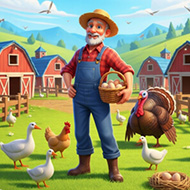
Every chicken, duck, goose, and turkey in Eggstreme Farming needs its own food and water containers refilled by hand, and that one detail decides how the entire early game feels: less about clicking a farm into existence and more about walking a route between animals who all get hungry on their own schedule.
| Genre | Farming Simulation |
| Animals | Chickens, ducks, geese, turkeys |
| Core Loop | Collect and sell eggs, reinvest in pens and licenses |
| Players | Single-player only |
The opening stretch of Eggstreme Farming keeps the animal roster small and the tasks simple: feed and water a handful of birds, collect what they produce, and sell trays of eggs through a vending machine rather than any abstract menu transaction. That vending-machine detail keeps the economy feeling grounded in the farm itself rather than in an off-screen spreadsheet.
Daily tasks built around collecting eggs, selling trays, and caring for animals generate experience points, and that XP is what unlocks new licenses rather than raw cash alone. This means a farm that is profitable but neglects its daily task list can still stall out on progression, since license unlocks gate access to renting new pens and expanding beyond the starting animal count.
Animal care in Eggstreme Farming goes beyond feeding. Players need to monitor animal health directly and apply medicines and vaccines when a bird needs them, which turns the farm into something closer to active livestock management than a passive idle simulator. Skipping health checks does not just risk one animal; it risks the production line that animal was contributing to.
Eggstreme Farming layers in ordinary overhead most farming games skip: water, electricity, and internet bills all need to be paid to keep the operation running smoothly. On top of upkeep, players can buy shelves, furniture, and plants to organize the space, which affects how efficiently items and animals can be managed rather than existing purely as decoration.
That combination of production and upkeep is what gives Eggstreme Farming its particular rhythm: income from eggs has to outpace the recurring cost of keeping lights, water, and connectivity running, which keeps early expansion decisions from feeling like a guaranteed win.
Growth in Eggstreme Farming is tied to renting new pens rather than simply purchasing more animals outright. Licenses unlocked through leveling gate access to larger production, which means players who focus purely on selling eggs without engaging the daily task and leveling system will hit a ceiling long before players who balance both.
Because the current build only includes a portion of the full roster of animals, equipment, furniture, and areas planned for the complete release, players exploring the available content are seeing an early slice of a farm that is designed to grow considerably larger over time.
The current line-up includes chickens, ducks, geese, and turkeys, each requiring their own feeding, watering, and health management rather than sharing a single generic care system.
Health needs direct attention. Players must monitor their animals and apply medicine or vaccines when needed, since problems do not resolve passively the way hunger or thirst might in a more automated farming title.
Completing daily tasks such as collecting eggs, selling trays, and caring for animals earns XP, and that XP is what unlocks new licenses, which in turn gate access to renting additional pens and expanding the farm further.
Beyond animal care, Eggstreme Farming asks players to actively organize the physical space of the farm itself, buying shelves, furniture, and plants specifically to keep items arranged efficiently rather than scattered. That organizational layer matters more as the operation grows, since a cluttered farm makes it harder to spot which containers need refilling or which animals are showing signs of needing medicine, turning tidiness into a practical advantage rather than a purely cosmetic choice.
Players who invest early in organizing shelves and storage tend to find later expansion smoother, since a farm that is already legible at a smaller scale stays manageable once more pens, more animals, and more daily tasks are layered on top of it.
Because the currently available build only includes a portion of the full roster of animals, equipment, furniture, and areas planned for the complete release, players working through the demo are seeing a genuine but limited slice of what Eggstreme Farming is building toward. The core loop, feed and water animals, monitor health, collect and sell eggs, manage bills, expand through licensing, is already fully in place, which means the demo experience reflects the eventual full game’s rhythm even though its content ceiling is intentionally capped for now.
That distinction matters for setting expectations. Players who reach the current content limit are not failing to find more to do through any fault of their own; they are simply reaching the edge of what the current build includes, with a considerably larger farm, animal roster, and set of systems planned beyond it.
Eggstreme Farming earns its name less through chaos and more through the accumulation of small, recurring chores across chickens, ducks, geese, and turkeys, where a farm that looks calm on the surface is really just one that has kept up with its bills, its vaccines, and its vending machine deliveries.
There are no reviews yet. Be the first one to write one.