ADVERTISEMENT
ADVERTISEMENT
 (No Ratings Yet)
 Loading...
Fullscreen
ADVERTISEMENT


 (No Ratings Yet)Loading...
Every object in People Playground carries its own weight, sharpness, thermal conductivity, electrical conductivity, ferromagnetism, heat capacity, and bullet resistance, and none of those properties are cosmetic; they all actively feed into a simulation that reacts to whatever players throw at it.
| Genre | Physics Sandbox |
| Core System | 2D ragdoll physics |
| Simulated Properties | Temperature, electricity, rigid body dynamics |
| Player Goal | None fixed; open-ended experimentation |
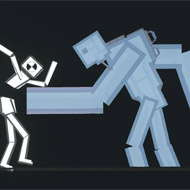
The characters in People Playground are not single rigid models but ragdolls made of interconnected body parts, which can separate or detach entirely under enough force or damage. That structure is what allows dismemberment and similarly dramatic outcomes to happen consistently rather than as scripted one-off events, since the underlying physics genuinely tracks mass, collision, and force across every connected piece.
Because every one of these properties is simulated rather than faked for a specific scripted moment, combining objects with different properties tends to produce results that were never explicitly programmed as a single outcome, which is exactly where much of the game’s replay value comes from.
People Playground simulates temperature directly, tracking heat transfer both through objects and through the surrounding air rather than treating heat as a simple damage-over-time effect. That means placing something hot near something flammable produces a genuinely simulated chain reaction rather than a pre-scripted explosion, and the outcome depends on the specific objects involved rather than a fixed animation.
Beyond heat, the game simulates electrical conductivity, letting players route electricity through conductive objects and characters alike, and allows direct manipulation of gravity within a scene. Certain maps add environmental elements like water, acid, and additional electrical hazards, giving players more variables to combine when testing how different materials and characters respond under specific conditions.
The phrase that comes up most often around People Playground is emergent gameplay, behavior that was never explicitly implemented as a single scripted feature but arises naturally from all of these systems, weight, sharpness, conductivity, heat, electricity, gravity, interacting simultaneously. A specific combination of objects and forces can produce an outcome the game’s own systems make possible without ever being individually designed by hand.
Unlike most simulation games, People Playground does not set a specific win condition or mission structure. The appeal is almost entirely in open-ended experimentation: dropping in ragdolls, objects, and hazards, then observing how the simulation resolves the interaction. That lack of a fixed goal is precisely why sessions vary so widely between players, since two people testing the same tools rarely arrive at the same result.
Because so many properties are tracked simultaneously, weight interacting with sharpness, heat interacting with conductivity, force interacting with ragdoll joints, the same rough setup rarely plays out identically twice. That variability is a direct result of the simulation depth rather than randomness layered on top, and it is a large part of why experienced players keep returning to test new combinations rather than treating any one scenario as fully explored.
No. The game has no fixed goal, and the appeal is centered on open-ended experimentation with the physics, temperature, and electrical systems rather than completing missions or objectives.
Because ragdoll characters are built from interconnected body parts that can separate under sufficient force or damage, dismemberment arises from the physics simulation itself rather than from a scripted animation triggered under specific conditions.
Temperature is fully simulated, including heat transfer through objects and through the air, which means placing a heat source near a flammable object can trigger a genuine chain reaction rather than a cosmetic effect.
Because so many simulated properties, weight, conductivity, heat capacity, and more, interact at once, small variations in force or placement can cascade into different outcomes, which is the emergent behavior the game is best known for.
Rather than functioning as levels to be completed, maps in People Playground act as testing grounds built around specific hazards or themes. Some emphasize water, letting players see how electrical objects behave once conductivity meets a liquid environment; others introduce acid, which interacts with object durability in ways separate from pure force or heat. Because these environmental elements are simulated alongside the same weight, conductivity, and heat systems that govern every other object, combining a map’s built-in hazards with items the player brings in produces the same kind of unscripted results the game is generally known for.
This map-as-testing-ground approach is part of why sessions rarely feel like they are working toward a defined finish line. A water-themed map does not have a win state; it has a set of conditions that make certain experiments, electrical objects near liquid, for instance, more interesting to run than they would be on a plain stage with no hazards at all.
Games built around genuinely simulated physics rather than scripted outcomes tend to build communities around sharing specific setups and discoveries rather than sharing completion times or high scores, since there is no formal objective to compare against. People Playground fits that pattern closely: players who find an especially interesting combination of heat, conductivity, and object placement tend to want to show it off precisely because the simulation depth means not everyone will get the same result trying to recreate it exactly.
That unpredictability is also why the game continues to reward long-term players rather than being fully exhausted after a handful of sessions. With this many interacting systems, weight, sharpness, thermal and electrical conductivity, ferromagnetism, heat capacity, bullet resistance, gravity, and more, the space of possible combinations stays large enough that new interactions keep surfacing well after the basics are understood.
People Playground earns its reputation less through any single feature and more through how many of those features, weight, conductivity, heat, electricity, gravity, all stay active and interacting at the same time, which is exactly why dropping the same handful of objects into a fresh scene rarely plays out quite the same way twice.
There are no reviews yet. Be the first one to write one.