ADVERTISEMENT
ADVERTISEMENT
 (No Ratings Yet)
 Loading...
Fullscreen
ADVERTISEMENT


 (No Ratings Yet)Loading...
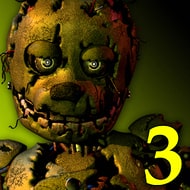
You glance at Cam 3, catch a soft whistle drifting through the monitor speaker, and your hand hovers over the audio button before you have confirmed where he actually is. That sound is the whole tension of Five Nights At Freddys 3 in miniature: you react to what you hear a few seconds before you see it, and by the time Springtrap is on camera it is often too late to do anything but seal a vent and hope.
| Genre | Point-and-click survival horror |
| Setting | Fazbear’s Fright: The Horror Attraction |
| Primary Threat | Springtrap |
Earlier games throw several animatronics at you at once, each with its own pattern. This one strips that down to a single roaming threat, Springtrap, the only animatronic in Fazbear’s Fright who can actually end your night. He stays dormant through Night 1 and starts moving on his own from Night 2 onward.
That narrower focus does not make the game easier. Every mechanic points at one problem: locating Springtrap, predicting his next move, and buying enough time to keep the maintenance systems from failing while you do it.
Players expecting a repeat of the earlier games’ animatronic-juggling often find the shift jarring. There is no cast of faces to memorize here, just one shape that could be almost anywhere in the building.
The whistle is the real early-warning system, and reading it matters more than watching any single feed. A soft, distant whistle usually means Springtrap is sitting in Cam 3 or Cam 5, still a room or two from your office.
A loud, close whistle is a different story. It means Springtrap is somewhere dangerous: Cam 1, Cam 2, the Vent Cam near Cam 15, the window, the door, or already inside with you.
New players keep their eyes glued to the monitor and miss the whistle changing pitch entirely. That is usually the exact moment they get caught off guard.
Springtrap does not just walk room to room like a normal animatronic. He can enter a vent adjacent to whatever camera he currently occupies, closing distance on your office far faster than his normal pace suggests.
Sealing the correct vent in time depends on noticing which camera he was last seen in, then anticipating which vent connects to your side. Guess wrong and you waste seconds you did not have to spare.
Community discussion around this game leans heavily on vent routing. Players trade notes on which cameras to check first depending on where Springtrap was last spotted.
Beyond watching Springtrap, you manage two failing systems: the camera network and ventilation, both of which can glitch out under strain. Losing ventilation too long affects your own awareness, while losing cameras blinds you to his position entirely.
Balancing repairs against active monitoring is where most nights are actually lost. Spend too long rebooting a system and you miss the whistle shift that told you Springtrap just moved into the vent beside you.
A rough order experienced players fall back on when everything fails at once:
Skip a step in that order and the whole night unravels fast. Most failed runs trace back to a system reboot that started a few seconds too late.
Every camera has a play-audio option, the closest thing the game gives you to actual control over Springtrap instead of just reacting to him. Playing audio in a room draws him toward that sound, letting you pull him away from the office.
The trick is not overusing it. Lure him into a room too close and you accomplish nothing; lure him into a camera far from Cam 1 and Cam 2 and you buy real breathing room.
Veteran players call this the only proactive tool in a game that otherwise forces you to play defense. It rewards patience over panic.
Springtrap is not the only thing on your screen. Phantom versions of the Classic, Withered, and Toy animatronics show up as hallucinations, and encountering one, especially Phantom Freddy in the hallway or Phantom Chica near Cam 7, does not kill you directly but triggers a jumpscare that knocks out a system.
Ignoring Phantoms because they cannot kill you outright is a common beginner mistake. The system damage they cause compounds with everything else already failing that night.
What a Phantom encounter usually costs you:
None of that damage is permanent on its own. Stacked with a close Springtrap, though, it is often enough to end the night outright.
The most common early mistake is flipping cameras constantly out of habit from the earlier games, which burns time better spent listening. The second is panicking at any whistle and sealing random vents instead of confirming Springtrap’s actual position first.
Players coming from the original two entries also forget there is no door to slam shut here. Survival is about systems management and misdirection, not a binary lock-out.
Fans stay split on the format itself. Some miss having several animatronics to track at once, while others consider the whistle-and-vent system the tensest mechanic the series has produced, and the rundown Fazbear’s Fright setting keeps both camps coming back regardless.
Five Nights At Freddys 3 succeeds by narrowing everything down to one relationship: you, Springtrap, and the whistle that tells you how much time is left. Whether you are luring him away from Cam 1 with an audio cue or scrambling to reboot ventilation before a Phantom catches you off guard, the game keeps circling back to that same sound cutting through Fazbear’s Fright.
There are no reviews yet. Be the first one to write one.




![Hello Kitty [HORROR]](https://gamesummertimesaga.com/wp-content/uploads/2025/03/hello-kitty-horror.jpg "Hello Kitty [HORROR]")